



since 1993
What Are You Looking For?

Choosing the wrong condenser doesn't just mean weak A/C—it drains fuel efficiency and shortens your compressor's life. To help buyers, repair shops, and fleet owners make the right call, here are the 5 critical quality signs you must check before purchasing.
Sign #1: Raw Material & Anti-Corrosion Proof
Since the condenser sits at the vehicle's front line, it takes a beating from rain, road salt, and debris.
What to Look For: Demand high-purity aluminum alloy with a zinc anti-corrosion coating. The tangible proof? Ask for the salt-spray test report. A quality unit will survive extended hours in the chamber; a substandard one will corrode and pinhole-leak within two years.
Sign #2: Microchannel Design (Not Old Tube-Fin)
Heat dissipation speed is non-negotiable for cabin comfort.
What to Look For: Insist on a parallel-flow microchannel structure. This is the industry benchmark. Compared to outdated tube-fin designs, it boosts heat dissipation by over 30%, uses less refrigerant, and saves fuel. If it doesn't have this design, it’s already obsolete—reject it.
Sign #3: Size Adaptability & OEM Standards
Even a slight deviation in dimensions can make installation time-consuming and create hidden risks of refrigerant leaks.
What to Look For: Select products molded strictly according to original factory data. For instance, a high-quality condenser for Honda City must have bracket holes, interface positions, and thickness that perfectly match the vehicle’s specific year model. Precise dimensions save technicians time and effort, ensuring no pipe stress occurs—especially critical for high-mileage Corollas where every seal counts.
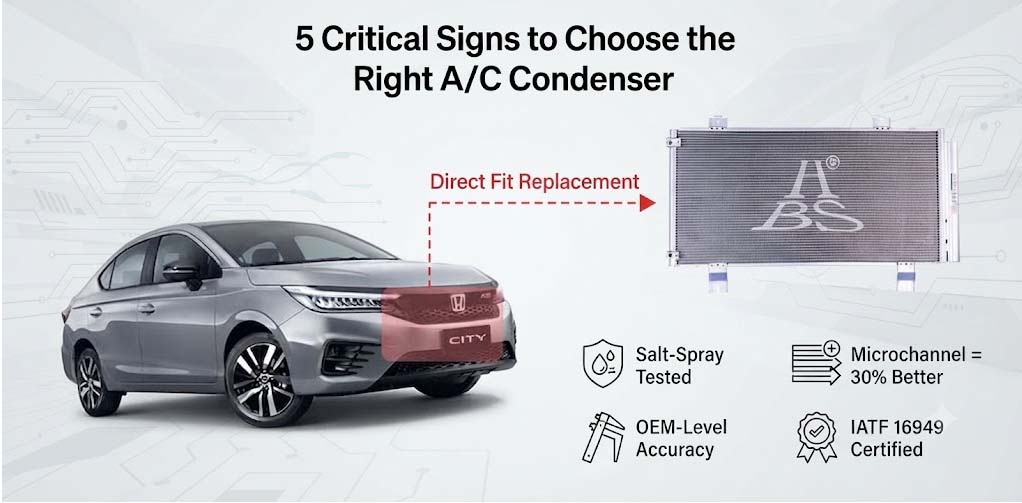
Sign #4: 100% Leak & Pressure Testing
A/C systems run under extreme high pressure. A single microscopic flaw leads to slow refrigerant loss.
What to Look For: Do not settle for "batch sampling." Ask specifically: "Do you perform 100% helium leak testing and burst testing on every unit?" Full-inspection products carry infinitely lower risk than those only spot-checked. This is the ultimate seal of sealing reliability.
Sign #5: IATF 16949 Certified Manufacturing
You cannot see internal weld quality with the naked eye. That makes the factory behind the product more important than the product itself.
What to Look For: Buy directly from a source factory with IATF 16949 certification. This isn't just a badge—it proves their management systems and welding processes pass rigorous automotive audits. Source factories guarantee stable quality and consistent supply, unlike intermediary traders who cannot control production.
Quick Buyer’s Q&A
Q1: How do I know if the problem is the condenser or the evaporator?
A: Use this quick diagnostic: The condenser (front of the vehicle) fails when clogged by stones or catkins—symptoms are poor cooling at idle but better cooling at highway speeds. The evaporator (inside the dash) suffers micro-leaks—symptoms are a refrigerant smell inside the cabin and constant cooling loss. Don't guess; use fluorescent dye or a nitrogen hold test for a definitive answer.
Q2: Why do you insist on microchannel over the old style?
A: Three reasons: Compact, Fast, Efficient. Smaller volume, faster heat rejection, and less refrigerant needed. It's standard on all new cars and is the only smart choice for aftermarket replacements.
Q3: How can I trust your quality claims?
A: As a certified source factory, we back it up with three tangible guarantees: ① IATF 16949 certification on file; ② 100% helium leak, pressure, and salt-spray testing per unit; ③ OEM-standard molds for zero-error dimensions. We encourage you to request samples and test them yourself—because proof is in the performance.
Tel : +86-20-36867580
Email : hbs_intl@gz-hbs.com
WhatsApp : +8615920167887
#29, Lingdong Rd.,Auto Base, Huadu District GuangZhou,510820,China


© 2026 HBS AUTO A/C FACTORY
